Sneffels
A Journey to the Centre of the EarthSneffels is the Icelandic volcano from which Professor Hardwigg’s expedition descends into the Earth, making it both the journey’s physical threshold and its enduring point of geographic reference. The travelers eventually emerge from another volcano more than twelve hundred leagues away, so Sneffels remains the measure of how far their underground passage has carried them.
Setting and Approach
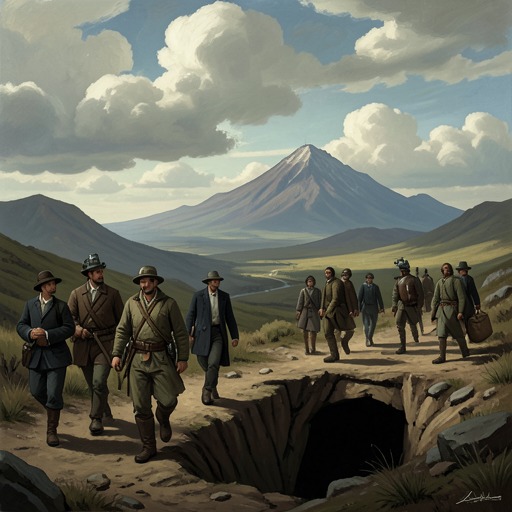
After landing in Iceland, the narrator sees the island’s landscape from Reykjavik: the town lies on a flat, marshy plain, with a vast lava field on one side and Faxa Bay on the other. The bay is bordered to the north by the enormous glacier of Sneffels. This view places the volcano within a stark geography of lava, sea, and ice before the expedition reaches its slopes.
On the ascent, Professor Hardwigg identifies the mountain’s two peaks, north and south. Hans names the peak on which the party stands as Scartaris. The mountain is not merely scenery: its summit and crater supply the landmarks by which the expedition identifies where its descent is to begin.
The Point of Entry
The expedition’s passage into the subterranean route makes Sneffels the decisive threshold between the familiar Icelandic landscape and the unknown world below. Its extinct state is crucial to the contrast at the end of the journey: the party does not return to the surface through the same mountain, but is carried through the chimney of a volcano in full activity.
The expedition also turns the mountain into a site of practical observation and record. Before proceeding, Professor Hardwigg takes a notebook intended for memoranda of their travels and records the date and the chronometer reading. The careful entry of time and instruments sets the measured, scientific register of the expedition against the scale and strangeness of the place it is entering.
A Geographic Measure
After the underground voyage across the inland sea, the narrator calculates the distance from the party’s journal observations. Since leaving Port Gretchen, they have traveled two hundred and seventy leagues—more than eight hundred miles—and are six hundred and twenty leagues from Iceland, exactly beneath England. The calculation gives the subterranean passage a map-like legibility: the travelers use measured distance to locate themselves in relation to the surface even when they are far below it.
Later, during the violent ascent through the active volcanic chimney, the compass’s sudden erratic movement leaves the party uncertain about where it will emerge. The narrator reasons that they have been swept northward many hundreds of leagues from Cape Saknussemm and considers whether they are again beneath Iceland, perhaps nearing Mount Hecla, or approaching another of the island’s volcanic outlets. Sneffels therefore remains part of the expedition’s mental geography even when the compass no longer provides a dependable guide.
Departure and Return to the Surface
The travelers emerge on Stromboli, more than twelve hundred leagues from Sneffels. The route joins two volcanoes, but the contrast between them marks the transformation of the journey: the party leaves the region of eternal snows and returns beneath Sicily’s blue sky, from icy conditions to abundant greenery. Sneffels is thus not the expedition’s exit but its point of departure, the fixed beginning against which the distance, danger, and changed landscape of the return become intelligible.